
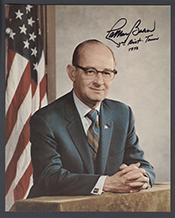
Historical · U.S. House · Tennessee · District 3
LaMar Baker
Former U.S. Representative · Tennessee District 3 · 1971–1975 · Republican
LaMar Baker represented Tennessee's District 3 in the United States House of Representatives (1971–1975) for the Republican party. The page below collects sourced biographical facts, term history, committee roles, and provenance for Baker.
Bioguide ID: B000069
Key facts
- Full name
- LaMar Baker
- State
- Tennessee
- District
- District 3
- Party
- Republican
- House service
- 1971–1975
- First House term
- 1971
- Status
- Left office
- Current term ends
- —
- Born
- 1915
- Bioguide ID
- B000069
- Committee assignments
- —
- Dataset version
- 1.20260605
Biographical narrative
890 words · sourced from the Wikipedia REST extract
LaMar Baker was a businessman and politician from Tennessee who served as a Republican member of the United States House of Representatives from 1971 to 1975. His political career included two terms in Congress, during which he represented Tennessee's 3rd congressional district. Prior to his time in the House, Baker was active in state politics, having served in both the Tennessee House of Representatives and the Tennessee State Senate. His tenure in Congress coincided with significant national events, including the Watergate scandal, which ultimately affected his political career.
Early life and career
LaMar Baker was born on December 29, 1915, in Chattanooga, Tennessee. He received his early education in the public school system of Chattanooga before pursuing higher education. Baker attended David Lipscomb College, now known as Lipscomb University, in Nashville from 1936 to 1938. He later earned a Bachelor of Science degree from Harding College in Searcy, Arkansas, in 1940. Both educational institutions are affiliated with the Churches of Christ, reflecting Baker's religious background.
During World War II, Baker served in the United States Army Air Forces from 1942 to 1946. His military service occurred during a critical period in American history, and it likely influenced his subsequent career in public service. After the war, Baker returned to Chattanooga, where he established himself as a successful businessman. His experience in the private sector provided him with a foundation for his later political endeavors.
Baker's political career began in 1966 when he was elected to the Tennessee House of Representatives. His involvement in state politics continued when he was elected to the Tennessee State Senate in 1968. These positions allowed him to gain valuable experience in legislative processes and public policy, which would serve him well in his future role as a U.S. Representative.
In 1970, Baker sought the Republican nomination for the congressional seat in Tennessee's 3rd district, which had become vacant following the election of Bill Brock to the United States Senate. Baker's campaign was successful, and he won a closely contested election in November of that year. His victory was aided by the political climate at the time, including the coattails of Brock's Senate campaign and the success of Republican gubernatorial candidate Winfield Dunn.
House tenure
Baker's first term in the U.S. House of Representatives began in January 1971. He was part of a Republican wave that swept through many districts during this period, as the party gained significant ground in the wake of the 1970 elections. His legislative work during this time included participation in various committees and engagement with issues pertinent to his constituents in Tennessee.
In 1972, Baker was reelected to a second term in Congress, which coincided with a broader Republican success in the state. President Richard Nixon's reelection campaign that year was particularly strong in Tennessee, where he won all but five counties. Baker's position as a sitting congressman likely contributed to his ability to secure reelection during this favorable political climate.
Despite his initial successes, Baker's tenure in Congress faced challenges. In 1974, he ran for reelection but was defeated by Democrat Marilyn Lloyd. This loss was attributed to several factors, including the national political climate following the Watergate scandal and Nixon's resignation earlier that year. The scandal had a significant impact on Republican candidates across the country, particularly in districts that were previously competitive.
Lloyd's candidacy was also notable for its personal dimension; she was the widow of Mort Lloyd, a local television anchorman who had died in a plane crash shortly after winning the Democratic primary. Her connection to the community and the circumstances surrounding her nomination likely played a role in her electoral success against Baker.
Following his defeat in 1974, Baker attempted to regain his congressional seat in 1976 but was unsuccessful in a rematch against Lloyd. The political landscape had shifted further, with the election of Jimmy Carter, a Democrat, to the presidency, which contributed to Baker's continued challenges in the political arena.
Legislative focus and committees
During his time in the House of Representatives, LaMar Baker was involved in various legislative initiatives and served on several committees. While specific details about his committee assignments and legislative priorities are not provided, it is common for members of Congress to focus on issues relevant to their constituents and the interests of their party. Baker's background as a businessman likely influenced his approach to economic and business-related legislation.
As a Republican representative from Tennessee, Baker would have engaged with issues pertinent to his district, which included economic development, transportation, and local infrastructure. His experience in the Tennessee State Legislature would have also informed his understanding of state-level issues that intersected with federal policies.
After leaving Congress, Baker continued to be active in public service. From 1981 to 1985, he served as a regional representative for the United States Secretary of Transportation during the administration of President Ronald W. Reagan. This role allowed him to remain engaged in governmental affairs and contribute to transportation policy at the federal level.
Baker spent his later years in Nashville, Tennessee, where he passed away on June 20, 2003. He is interred in Woodlawn Cemetery in Nashville, marking the end of a life that encompassed significant contributions to both state and national politics. His career reflects the complexities of American political life during a transformative period in the 20th century.
Notable legislation
Sponsored and co-sponsored legislation for LaMar Baker is pending operator curation. The biographical narrative above carries the same provenance trail until per-bill rows are written.
Sources
- [1]https://en.wikipedia.org/wiki/LaMar_BakerWikipedia · retrieved 2026-06-05
Notable quotes
Sourced quotes for LaMar Baker are pending operator curation. Narrative-scope provenance remains attached below.
Sources
- [1]https://en.wikipedia.org/wiki/LaMar_BakerWikipedia · retrieved 2026-06-05
Key positions
Curated policy positions for LaMar Baker are pending operator review. The biographical narrative above carries the same provenance trail until per-topic positions are written.
Sources
- [1]https://en.wikipedia.org/wiki/LaMar_BakerWikipedia · retrieved 2026-06-05
Terms served
- 1971–1973U.S. House · Term 1 · Republican
- 1973–1975U.S. House · Term 2 · Republican
Sources & provenance
Every attributable claim above carries a per-section [N] marker that resolves to the corresponding URL below. Each entry records the upstream provider, the canonical URL, and the timestamp at which the source was retrieved by the ingest pipeline.
Key facts
- https://bioguide.congress.gov/search/bio/B000069bioguide · retrieved 2026-06-05
- https://www.govtrack.us/congress/members/401072govtrack · retrieved 2026-06-05
Biographical narrative
- https://en.wikipedia.org/wiki/LaMar_Bakerwikipedia · retrieved 2026-06-05
Find your representative
Every U.S. state elects representatives by district. Browse Tennessee’s delegation, the full former-representative roster, or explore the role and term length.
Related on The Candidate
- Preceded by James Frazier Jr.Earlier holder of the Tennessee District 3 House seat · Democratic.Open
- Succeeded by Marilyn LloydLater holder of the Tennessee District 3 House seat · Democratic.Open
- Albert WatkinsFormer U.S. Representative · Tennessee District 1 · DemocraticOpen
- Alfred TaylorFormer U.S. Representative · Tennessee District 1 · RepublicanOpen
- Augustus PettiboneFormer U.S. Representative · Tennessee District 1 · RepublicanOpen
- Bill JenkinsFormer U.S. Representative · Tennessee District 1 · RepublicanOpen