
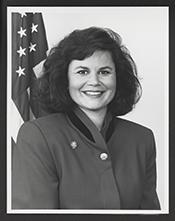
Historical · U.S. House · Utah · District 2
Enid Greene Waldholtz
Former U.S. Representative · Utah District 2 · 1995–1997 · Republican
Enid Greene Waldholtz represented Utah's District 2 in the United States House of Representatives (1995–1997) for the Republican party. The page below collects sourced biographical facts, term history, committee roles, and provenance for Waldholtz.
Bioguide ID: G000408
Key facts
- Full name
- Enid Greene Waldholtz
- State
- Utah
- District
- District 2
- Party
- Republican
- House service
- 1995–1997
- First House term
- 1995
- Status
- Left office
- Current term ends
- —
- Born
- 1958
- Bioguide ID
- G000408
- Committee assignments
- —
- Dataset version
- 1.20260605
Biographical narrative
903 words · sourced from the Wikipedia REST extract
Enid Greene Waldholtz is a former American politician who served as a U.S. Representative for Utah's 2nd congressional district from 1995 until 1997. A member of the Republican Party, she was notable for being the third woman and the first Republican woman elected to Congress from the state of Utah. Her congressional career was marked by significant personal and political challenges, including a financial scandal involving her then-husband, which ultimately led her to decide not to seek re-election.
Early life and career
Enid Greene was born on June 5, 1958, in San Rafael, California. She was raised in a family with a military background, as her father, D. Forrest Greene, served as a naval officer and financier. Enid is one of five siblings. She completed her secondary education at East High School before pursuing higher education at the University of Utah, where she earned a Bachelor of Arts degree in 1980. Following her undergraduate studies, she attended Brigham Young University, obtaining her Juris Doctor degree in 1983.
After completing her education, Greene began her professional career as a lawyer. She initially worked for Novell, a software company, before joining a law firm in Salt Lake City. Her political career began to take shape when she served as deputy chief of staff for Utah Governor Norman H. Bangerter. In addition to her legal and political roles, Greene was actively involved in Republican politics, co-directing Ronald Reagan's campaign in Utah alongside Jon Huntsman Jr.
Greene's initial foray into electoral politics occurred in 1992 when she ran for the U.S. House of Representatives, challenging incumbent Karen Shepherd for Utah's 2nd congressional district. Despite a competitive campaign, Greene lost the election by a narrow margin of four percentage points. This experience, however, laid the groundwork for her subsequent political ambitions.
House tenure
In 1994, Greene made a second attempt to secure a seat in the U.S. House of Representatives, this time successfully defeating Shepherd in a rematch. Her campaign was notable for its significant financial backing, with expenditures totaling approximately $2 million, making it one of the most expensive House races in the country that year. Greene's victory was part of a larger Republican wave that swept through the midterm elections, leading to a shift in control of Congress.
Upon her election, Greene was appointed to the House Rules Committee, making her the first freshman representative to serve on that committee in over 80 years. Her tenure in Congress began with a notable personal milestone; in March 1995, she announced her pregnancy, becoming only the second representative in U.S. history to give birth while in office, following Yvonne Brathwaite Burke. This event highlighted Greene's role as a trailblazer for women in politics, particularly within the Republican Party.
However, Greene's time in office was overshadowed by a significant scandal involving her husband, Joe Waldholtz. Allegations arose regarding financial misconduct related to her campaign, with reports indicating that a substantial portion of the funds used in her campaign had been embezzled by Waldholtz. In November 1995, Waldholtz disappeared for several days before surrendering to authorities, during which time Greene announced her intention to divorce him and sought custody of their daughter.
The scandal culminated in Waldholtz pleading guilty to multiple federal charges, including tax and campaign fraud. Under pressure from her party and constituents, Greene announced in March 1996 that she would not seek re-election. Her decision marked a significant moment in Utah's political landscape, as no woman would be elected to a federal congressional seat from the state until 2014.
Legislative focus and committees
During her brief tenure in the U.S. House of Representatives, Greene's legislative focus encompassed various issues pertinent to her constituents and the broader Republican agenda. As a member of the House Rules Committee, she participated in shaping the legislative process and influencing the flow of bills through Congress. Her position on this committee allowed her to engage directly with the procedural aspects of lawmaking, although specific legislative initiatives she championed during her time in office are not extensively documented.
Greene's involvement in the Republican Party extended beyond her congressional duties. Following her departure from the House, she gradually re-entered Utah state politics. In 2003, she was elected vice chair of the Utah Republican Party, demonstrating her continued commitment to the party and its principles. She later ran for the position of Lieutenant Governor of Utah in 2004 but was unsuccessful in the Republican primary.
After her primary defeat, Greene continued to hold leadership roles within the Utah Republican Party. She served as acting chair following the resignation of Joe Cannon in late 2006 and was subsequently elected as the state party chair in early 2007. Her leadership in these roles reflected her ongoing influence within the party at the state level.
In her personal life, Greene remarried in 2008 to Scott J. Mickelsen, a former sheriff's deputy who later became a judge. Throughout her post-congressional career, she remained active in Republican politics, serving as a delegate at the 2012 Republican National Convention and chairing the 2016 Republican National Convention Site Selection Committee. Additionally, she was appointed by the Republican National Committee chair to lead the 2016 Republican Convention Rules Committee.
Enid Greene Waldholtz's political journey illustrates the complexities of navigating public service, personal challenges, and the evolving role of women in American politics. Her experiences reflect both the opportunities and obstacles faced by female politicians, particularly in a historically male-dominated environment.
Notable legislation
Sponsored and co-sponsored legislation for Enid Greene Waldholtz is pending operator curation. The biographical narrative above carries the same provenance trail until per-bill rows are written.
Sources
- [1]https://en.wikipedia.org/wiki/Enid_Greene_MickelsenWikipedia · retrieved 2026-06-05
Notable quotes
Sourced quotes for Enid Greene Waldholtz are pending operator curation. Narrative-scope provenance remains attached below.
Sources
- [1]https://en.wikipedia.org/wiki/Enid_Greene_MickelsenWikipedia · retrieved 2026-06-05
Key positions
Curated policy positions for Enid Greene Waldholtz are pending operator review. The biographical narrative above carries the same provenance trail until per-topic positions are written.
Sources
- [1]https://en.wikipedia.org/wiki/Enid_Greene_MickelsenWikipedia · retrieved 2026-06-05
Terms served
- 1995–1997U.S. House · Term 1 · Republican
Sources & provenance
Every attributable claim above carries a per-section [N] marker that resolves to the corresponding URL below. Each entry records the upstream provider, the canonical URL, and the timestamp at which the source was retrieved by the ingest pipeline.
Key facts
- https://bioguide.congress.gov/search/bio/G000408bioguide · retrieved 2026-06-05
- https://www.govtrack.us/congress/members/411214govtrack · retrieved 2026-06-05
Biographical narrative
- https://en.wikipedia.org/wiki/Enid_Greene_Mickelsenwikipedia · retrieved 2026-06-05
Find your representative
Every U.S. state elects representatives by district. Browse Utah’s delegation, the full former-representative roster, or explore the role and term length.
Related on The Candidate
- Preceded by Karen ShepherdEarlier holder of the Utah District 2 House seat · Democratic.Open
- Succeeded by Merrill CookLater holder of the Utah District 2 House seat · Republican.Open
- Clarence AllenFormer U.S. Representative · Utah District 1 · RepublicanOpen
- Don ColtonFormer U.S. Representative · Utah District 1 · RepublicanOpen
- Douglas StringfellowFormer U.S. Representative · Utah District 1 · RepublicanOpen
- Henry DixonFormer U.S. Representative · Utah District 1 · RepublicanOpen