
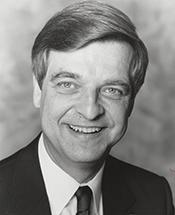
Historical · U.S. House · Michigan · District 3
Paul Henry
Former U.S. Representative · Michigan District 3 · 1985–1993 · Republican
Paul Henry represented Michigan's District 3 in the United States House of Representatives (1985–1993) for the Republican party. The page below collects sourced biographical facts, term history, committee roles, and provenance for Henry.
Bioguide ID: H000514
Key facts
- Full name
- Paul Henry
- State
- Michigan
- District
- District 3
- Party
- Republican
- House service
- 1985–1993
- First House term
- 1985
- Status
- Left office
- Current term ends
- —
- Born
- 1942
- Bioguide ID
- H000514
- Committee assignments
- —
- Dataset version
- 1.20260605
Biographical narrative
1,002 words · sourced from the Wikipedia REST extract
Paul B. Henry was an American politician and educator who served as a U.S. Representative for Michigan's 3rd congressional district from 1985 until his death in 1993. A member of the Republican Party, Henry was known for his background in political science and his commitment to public service. His tenure in Congress was marked by his involvement in various committees and his advocacy on issues related to education and the arts. He passed away from brain cancer at the age of 51, leaving a legacy that includes educational institutions and infrastructure named in his honor.
Early life and career
Paul B. Henry was born on July 9, 1942, in Chicago, Illinois. He completed his secondary education at Pasadena High School in Pasadena, California, graduating in 1959. Henry came from a notable family; his father, Carl F. H. Henry, was a prominent theologian and one of the founders of Fuller Theological Seminary, as well as the founding editor of Christianity Today. His mother, Helga Bender Henry, was an author with roots in Cameroon, West Africa, where she was born to German-American missionaries.
Henry pursued higher education at Wheaton College in Wheaton, Illinois, where he earned a Bachelor of Arts degree in 1963. Following his graduation, he served as a volunteer in the Peace Corps from 1963 to 1965, working in Liberia and Ethiopia. After his time in the Peace Corps, he returned to the United States to further his studies at Duke University in Durham, North Carolina. He obtained a Master of Arts degree in 1968 and subsequently earned a PhD in 1970.
Henry began his professional career as a professor of political science at Calvin College in Grand Rapids, Michigan, where he taught from 1970 until 1978. His academic background and expertise in political science provided a foundation for his later political endeavors.
In addition to his academic work, Henry gained political experience while he was a graduate student at Duke University. He served as a staff member for Congressman John B. Anderson, a Republican from Illinois, during two separate periods from 1965 to 1970. His role involved facilitating communication within the party caucus, particularly during a time when Anderson held a significant position in Congress.
Henry's political career took a more defined shape in the 1970s. After the Watergate scandal led to a shift in political power, he was appointed as the chairman of the Kent County Republican Party, where he worked to revitalize the local party. In 1975, he was appointed by Michigan Governor William Milliken to serve on the Michigan State Board of Education, a position he held until 1978. Following this, he successfully ran for an open seat in the Michigan State House of Representatives, representing the 91st district from 1979 to 1982. He then advanced to the Michigan State Senate, where he served one term representing the 32nd district.
House tenure
In 1984, Paul Henry was elected to the U.S. House of Representatives as a Republican from Michigan's 5th District, succeeding Congressman Harold S. Sawyer. The district, which included Grand Rapids, had historically been a Republican stronghold but had shifted to Democratic representation in previous elections. Henry's election marked a return to Republican control, as he won the seat with a significant majority of the vote.
Henry's first term in Congress began on January 3, 1985, and he was re-elected multiple times, serving a total of five terms until his death on July 31, 1993. His tenure in the House was characterized by his active participation in various committees, including the Committee on Education and Labor, the Committee on Science, Space and Technology, and the Select Committee on Aging. Throughout his time in Congress, Henry focused on issues related to education, labor, and the intersection of science and technology with public policy.
During his time in office, Henry was known for his stance on federal funding for the arts. He opposed the allocation of federal funds for what he deemed offensive artwork, although he did not advocate for the complete defunding of federal support for the arts. His positions reflected a nuanced approach to cultural issues, balancing fiscal responsibility with support for artistic endeavors.
Henry's congressional career was cut short by health issues. In October 1992, he was diagnosed with a brain tumor, which led to surgery shortly before he was re-elected to his fifth term. Despite initially regaining strength and attending his swearing-in for the 103rd Congress in January 1993, his health declined rapidly thereafter. He passed away in Grand Rapids, Michigan, at the age of 51, after a nine-month battle with brain cancer.
Legislative focus and committees
During his time in the U.S. House of Representatives, Paul Henry was involved in a range of legislative issues, particularly those related to education and labor. As a member of the Committee on Education and Labor, he worked on policies aimed at improving educational opportunities and labor relations. His academic background in political science informed his approach to these issues, allowing him to contribute meaningfully to discussions and legislation.
Henry also served on the Committee on Science, Space and Technology, where he engaged with matters related to scientific research, technological advancement, and their implications for society. His involvement in the Select Committee on Aging highlighted his commitment to addressing the needs and concerns of older Americans, a demographic that was increasingly becoming a focus of national policy discussions.
Throughout his legislative career, Henry was recognized for his principled stances, particularly regarding federal funding for the arts. His opposition to certain forms of government funding reflected his belief in the importance of maintaining standards in public art, while still acknowledging the value of federal support for the arts in general.
Henry's contributions to Congress and his advocacy on various issues left a lasting impact on his constituents and the broader political landscape. His legacy is commemorated through several institutions and initiatives named in his honor, including educational programs and infrastructure projects. His commitment to public service and education continues to be recognized in Michigan and beyond.
Notable legislation
Sponsored and co-sponsored legislation for Paul Henry is pending operator curation. The biographical narrative above carries the same provenance trail until per-bill rows are written.
Sources
- [1]https://en.wikipedia.org/wiki/Paul_B._HenryWikipedia · retrieved 2026-06-05
Notable quotes
Sourced quotes for Paul Henry are pending operator curation. Narrative-scope provenance remains attached below.
Sources
- [1]https://en.wikipedia.org/wiki/Paul_B._HenryWikipedia · retrieved 2026-06-05
Key positions
Curated policy positions for Paul Henry are pending operator review. The biographical narrative above carries the same provenance trail until per-topic positions are written.
Sources
- [1]https://en.wikipedia.org/wiki/Paul_B._HenryWikipedia · retrieved 2026-06-05
Terms served
- 1985–1987U.S. House · Term 1 · Republican
- 1987–1989U.S. House · Term 2 · Republican
- 1989–1991U.S. House · Term 3 · Republican
- 1991–1993U.S. House · Term 4 · Republican
- 1993–1993U.S. House · Term 5 · Republican
Sources & provenance
Every attributable claim above carries a per-section [N] marker that resolves to the corresponding URL below. Each entry records the upstream provider, the canonical URL, and the timestamp at which the source was retrieved by the ingest pipeline.
Key facts
- https://bioguide.congress.gov/search/bio/H000514bioguide · retrieved 2026-06-05
- https://www.govtrack.us/congress/members/405377govtrack · retrieved 2026-06-05
Biographical narrative
- https://en.wikipedia.org/wiki/Paul_B._Henrywikipedia · retrieved 2026-06-05
Find your representative
Every U.S. state elects representatives by district. Browse Michigan’s delegation, the full former-representative roster, or explore the role and term length.
Related on The Candidate
- Preceded by Garry BrownEarlier holder of the Michigan District 3 House seat · Republican.Open
- Succeeded by Vernon EhlersLater holder of the Michigan District 3 House seat · Republican.Open
- Alexander BuelFormer U.S. Representative · Michigan District 1 · DemocraticOpen
- Alfred LuckingFormer U.S. Representative · Michigan District 1 · DemocraticOpen
- Alpheus WilliamsFormer U.S. Representative · Michigan District 1 · DemocraticOpen
- Bart StupakFormer U.S. Representative · Michigan District 1 · DemocraticOpen