
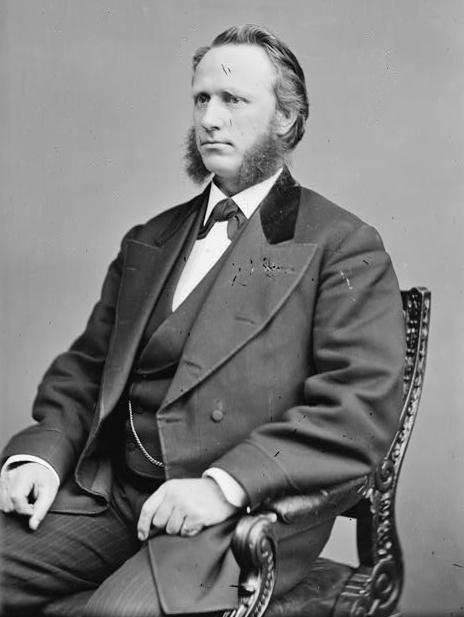
Historical · U.S. House · Missouri · District 1
Edwin Stanard
Former U.S. Representative · Missouri District 1 · 1873–1875 · Republican
Edwin Stanard represented Missouri's District 1 in the United States House of Representatives (1873–1875) for the Republican party. The page below collects sourced biographical facts, term history, committee roles, and provenance for Stanard.
Bioguide ID: S000787
Key facts
- Full name
- Edwin Stanard
- State
- Missouri
- District
- District 1
- Party
- Republican
- House service
- 1873–1875
- First House term
- 1873
- Status
- Left office
- Current term ends
- —
- Born
- 1832
- Bioguide ID
- S000787
- Committee assignments
- —
- Dataset version
- 1.20260606
Biographical narrative
897 words · sourced from the Wikipedia REST extract
Edwin Stanard was an American politician and businessman who served as a U.S. Representative for Missouri's 1st congressional district. A member of the Republican Party, he held office in the House of Representatives from 1873 to 1875. In addition to his congressional service, Stanard was also the lieutenant governor of Missouri and had a notable career in banking and milling. His contributions to both the political and business landscapes of Missouri reflect a diverse professional background that spanned several decades.
Early life and career
Edwin Stanard was born on January 5, 1832, in Newport, New Hampshire. His early life was marked by a significant move when, in 1836, his family relocated to the Iowa Territory. This transition occurred during a period of westward expansion in the United States, which would shape much of Stanard's later endeavors. He received his education in preparatory schools, laying the groundwork for his future pursuits in both education and business.
In 1853, Stanard moved to St. Louis, Missouri, where he began to establish his career. His early professional life included a role as an educator in Madison County, Illinois, during the years 1854 and 1855. This experience in education was complemented by his graduation from the St. Louis Commercial College in 1855, which equipped him with the skills necessary for a career in banking. By 1856, he had entered the banking sector, where he would eventually take on leadership roles at various financial institutions. His banking career included significant positions at the Boatmen's Bank, the Merchants Exchange, and the St. Louis Union Trust Bank Company.
In addition to his banking career, Stanard was involved in the milling industry. In 1860, he co-founded the Stanard-Tilton Milling Company, which played a crucial role in the production of flour. The company's flour mill in Dallas has been recognized for its historical significance and is listed on the National Register of Historic Places. Stanard's diverse professional background not only highlights his adaptability but also reflects the economic landscape of the time, which was influenced by agriculture and manufacturing.
House tenure
Edwin Stanard's political career began to take shape when he became a member of the Republican Party, which was emerging as a significant political force in the United States during the 19th century. He served as the lieutenant governor of Missouri from 1869 to 1871, a role that provided him with valuable experience in state governance and politics. His tenure as lieutenant governor was marked by the challenges and opportunities of the post-Civil War era, a time when the nation was grappling with issues of reconstruction and economic recovery.
In 1873, Stanard was elected to the United States House of Representatives, representing Missouri's 1st congressional district. His term in the House lasted from March 4, 1873, until March 3, 1875. During this period, he participated in the legislative process at a time when the country was undergoing significant changes, including the ongoing effects of the Civil War and the expansion of the federal government’s role in various aspects of American life. Stanard's time in Congress was characterized by his alignment with Republican principles, which included support for economic development and infrastructure improvements.
Despite his service in the House, Stanard was unable to secure re-election after his first term. His political career continued to evolve, as he remained active in Republican Party activities. Notably, he served on the Arrangements Committee during the 1880 Republican National Convention and was a delegate to the 1896 Convention. These roles underscored his ongoing commitment to the party and its platform, even after his congressional tenure had ended.
Legislative focus and committees
During his time in the House of Representatives, Edwin Stanard's legislative focus aligned with the broader goals of the Republican Party, which included economic development, infrastructure, and the promotion of business interests. While specific details regarding the bills he sponsored or voted on are not documented, it can be inferred that his background in banking and milling informed his perspective on economic issues. Given the era in which he served, it is likely that he engaged with legislation related to post-war recovery, industrial growth, and the expansion of transportation networks, which were critical to the economic development of the United States at the time.
Stanard's involvement in the Republican National Conventions further illustrates his engagement with national politics beyond his congressional duties. His participation in these conventions allowed him to influence party direction and policy, reflecting his commitment to the Republican ideals of the time. His professional experiences in banking and milling may have also provided him with insights into the economic challenges facing the nation, which could have influenced his legislative priorities while in office.
After his congressional service, Stanard returned to the milling industry, continuing to contribute to the economic landscape of Missouri. His work in this sector, combined with his earlier political roles, highlights a career that spanned both public service and private enterprise. Edwin Stanard's life and career exemplify the interconnectedness of business and politics during a transformative period in American history.
Edwin Stanard passed away on March 11, 1914, in St. Louis, Missouri, at the age of 82. His contributions to both the political and economic spheres of Missouri remain a part of the historical narrative of the state and the nation. He was laid to rest at Bellefontaine Cemetery, leaving behind a legacy that reflects the complexities of 19th-century American life.
Notable legislation
Sponsored and co-sponsored legislation for Edwin Stanard is pending operator curation. The biographical narrative above carries the same provenance trail until per-bill rows are written.
Sources
- [1]https://en.wikipedia.org/wiki/Edwin_O._StanardWikipedia · retrieved 2026-06-06
Notable quotes
Sourced quotes for Edwin Stanard are pending operator curation. Narrative-scope provenance remains attached below.
Sources
- [1]https://en.wikipedia.org/wiki/Edwin_O._StanardWikipedia · retrieved 2026-06-06
Key positions
Curated policy positions for Edwin Stanard are pending operator review. The biographical narrative above carries the same provenance trail until per-topic positions are written.
Sources
- [1]https://en.wikipedia.org/wiki/Edwin_O._StanardWikipedia · retrieved 2026-06-06
Terms served
- 1873–1875U.S. House · Term 1 · Republican
Sources & provenance
Every attributable claim above carries a per-section [N] marker that resolves to the corresponding URL below. Each entry records the upstream provider, the canonical URL, and the timestamp at which the source was retrieved by the ingest pipeline.
Key facts
- https://bioguide.congress.gov/search/bio/S000787bioguide · retrieved 2026-06-06
- https://www.govtrack.us/congress/members/410253govtrack · retrieved 2026-06-06
Biographical narrative
- https://en.wikipedia.org/wiki/Edwin_O._Stanardwikipedia · retrieved 2026-06-06
Find your representative
Every U.S. state elects representatives by district. Browse Missouri’s delegation, the full former-representative roster, or explore the role and term length.
Related on The Candidate
- Preceded by William PileEarlier holder of the Missouri District 1 House seat · Republican.Open
- Succeeded by Edward KehrLater holder of the Missouri District 1 House seat · Democratic.Open
- Anthony IttnerFormer U.S. Representative · Missouri District 1 · RepublicanOpen
- Bill Clay Sr.Former U.S. Representative · Missouri District 1 · DemocraticOpen
- Charles ClarkFormer U.S. Representative · Missouri District 1 · RepublicanOpen
- Clare MageeFormer U.S. Representative · Missouri District 1 · DemocraticOpen