
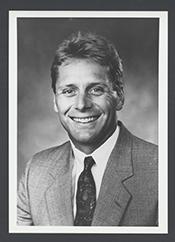
Historical · U.S. House · Oklahoma · District 1
Steve Largent
Former U.S. Representative · Oklahoma District 1 · 1994–2002 · Republican
Steve Largent represented Oklahoma's District 1 in the United States House of Representatives (1994–2002) for the Republican party. The page below collects sourced biographical facts, term history, committee roles, and provenance for Largent.
Bioguide ID: L000096
Key facts
- Full name
- Steve Largent
- State
- Oklahoma
- District
- District 1
- Party
- Republican
- House service
- 1994–2002
- First House term
- 1994
- Status
- Left office
- Current term ends
- —
- Born
- 1954
- Bioguide ID
- L000096
- Committee assignments
- —
- Dataset version
- 1.20260605
Biographical narrative
900 words · sourced from the Wikipedia REST extract
Stephen Michael Largent, born on September 28, 1954, is a former American professional football wide receiver and politician who served as a U.S. Representative for Oklahoma's 1st congressional district from 1994 until 2002. A member of the Republican Party, Largent is recognized for his significant contributions to both sports and politics. Before his political career, he had a distinguished tenure in the National Football League (NFL), primarily with the Seattle Seahawks, where he became one of the most celebrated wide receivers in the history of the sport.
Early life and career
Steve Largent was born in 1954 and grew up in a family that faced various challenges. He attended the University of Tulsa, where he played college football and studied biology. During his time at Tulsa, Largent established himself as a standout player, achieving impressive statistics that included 884 receiving yards and 14 touchdown catches in his junior year, followed by 1,000 receiving yards and another 14 touchdowns in his senior year. Despite his All-American status and notable college performance, Largent was not selected until the fourth round of the 1976 NFL Draft, where he was picked by the Houston Oilers.
Initially, Largent's NFL career appeared uncertain. After a brief stint with the Oilers, he was informed that he would be released. However, his former college offensive coordinator, Jerry Rhome, who was now with the expansion Seattle Seahawks, advocated for Largent, leading to a trade that allowed him to join the Seahawks. Largent's early experiences with the team were marked by personal struggles, including financial difficulties and family responsibilities. Nevertheless, he persevered and made the roster for the Seahawks' inaugural season.
Over the course of his 14-year career with the Seahawks, Largent became known for his exceptional route-running and reliable hands. He was not the fastest player on the field, but his ability to find open space and catch passes made him a key asset to the team. Largent's connection with quarterback Jim Zorn was particularly noteworthy, as they formed one of the most productive passing duos in the league during the late 1970s and early 1980s. Largent's performance earned him multiple Pro Bowl selections and established him as a leading figure in the franchise's history.
House tenure
Largent transitioned from professional football to politics after retiring from the NFL in 1989. He entered the political arena and was elected to the U.S. House of Representatives in 1994, representing Oklahoma's 1st congressional district. His election marked the beginning of a significant political career, during which he served four consecutive terms in the House. Largent consistently garnered substantial support from his constituents, winning over 60% of the vote in each election.
During his time in Congress, Largent was involved in various legislative initiatives and worked on issues pertinent to his district and the nation. His tenure in the House was characterized by a commitment to his constituents and a focus on policies that aligned with his Republican values. Largent's political career included a bid for the governorship of Oklahoma in 2002, where he was the Republican nominee. Although he did not win the election, his candidacy reflected his continued engagement in public service and his desire to influence state governance.
Largent's decision to resign from Congress in 2002 was primarily motivated by his gubernatorial campaign. His departure from the House marked the end of an era during which he had established himself as a prominent figure in both sports and politics. Following his congressional career, Largent continued to be involved in various civic and community activities, maintaining a presence in Oklahoma and beyond.
Legislative focus and committees
During his time in the U.S. House of Representatives, Largent's legislative focus encompassed a range of issues, reflecting both his personal interests and the needs of his constituents. As a member of the Republican Party, he aligned himself with conservative principles, advocating for policies that promoted economic growth, limited government, and individual liberties. His background as a professional athlete also informed his perspective on issues related to sports, health, and wellness.
Largent served on several committees during his congressional tenure, which allowed him to influence legislation in areas such as commerce, education, and health. His experience in the NFL provided him with unique insights into the challenges faced by athletes and sports organizations, enabling him to advocate effectively for policies that supported the sports community. He was particularly interested in issues related to youth sports and the importance of physical education in schools.
In addition to his focus on sports-related legislation, Largent was involved in broader policy discussions, including those concerning economic development and healthcare. He sought to address the needs of his constituents through initiatives aimed at improving local economies and ensuring access to quality healthcare services. His work in Congress demonstrated a commitment to representing the interests of Oklahomans and contributing to national policy debates.
Largent's dual legacy as a professional athlete and a public servant highlights his diverse contributions to American society. His career in the NFL, marked by numerous accolades and records, laid the foundation for his subsequent political endeavors. Through his service in the U.S. House of Representatives, Largent continued to influence the lives of many, advocating for policies that reflected his values and the needs of his community. Although he concluded his congressional career in 2002, Largent's impact on both sports and politics remains significant, illustrating the interconnectedness of these two realms in American life.
Notable legislation
Sponsored and co-sponsored legislation for Steve Largent is pending operator curation. The biographical narrative above carries the same provenance trail until per-bill rows are written.
Sources
- [1]https://en.wikipedia.org/wiki/Steve_LargentWikipedia · retrieved 2026-06-05
Notable quotes
Sourced quotes for Steve Largent are pending operator curation. Narrative-scope provenance remains attached below.
Sources
- [1]https://en.wikipedia.org/wiki/Steve_LargentWikipedia · retrieved 2026-06-05
Key positions
Curated policy positions for Steve Largent are pending operator review. The biographical narrative above carries the same provenance trail until per-topic positions are written.
Sources
- [1]https://en.wikipedia.org/wiki/Steve_LargentWikipedia · retrieved 2026-06-05
Terms served
- 1994–1995U.S. House · Term 1 · Republican
- 1995–1997U.S. House · Term 2 · Republican
- 1997–1999U.S. House · Term 3 · Republican
- 1999–2001U.S. House · Term 4 · Republican
- 2001–2002U.S. House · Term 5 · Republican
Sources & provenance
Every attributable claim above carries a per-section [N] marker that resolves to the corresponding URL below. Each entry records the upstream provider, the canonical URL, and the timestamp at which the source was retrieved by the ingest pipeline.
Key facts
- https://bioguide.congress.gov/search/bio/L000096bioguide · retrieved 2026-06-05
- https://www.govtrack.us/congress/members/400593govtrack · retrieved 2026-06-05
Biographical narrative
- https://en.wikipedia.org/wiki/Steve_Largentwikipedia · retrieved 2026-06-05
Find your representative
Every U.S. state elects representatives by district. Browse Oklahoma’s delegation, the full former-representative roster, or explore the role and term length.
Related on The Candidate
- Preceded by James JonesEarlier holder of the Oklahoma District 1 House seat · Democratic.Open
- Succeeded by John SullivanLater holder of the Oklahoma District 1 House seat · Republican.Open
- Bird McGuireFormer U.S. Representative · Oklahoma District 1 · RepublicanOpen
- Charles O’ConnorFormer U.S. Representative · Oklahoma District 1 · RepublicanOpen
- Dixie GilmerFormer U.S. Representative · Oklahoma District 1 · DemocraticOpen
- Everette HowardFormer U.S. Representative · Oklahoma District 1 · DemocraticOpen